Archive for the ‘Examiner.com’ Category

Torrey Smith’s four touchdowns pace Terps in 38-31 win over Wolfpack

November 28, 2010

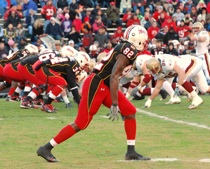
Maryland's Torrey Smith, seen here vs. Boston College in 2009, scored four TDs Saturday in the Terps' 38-31 win over N.C. State. Photo: Keith Lovett via Flickr.

Torrey Smith caught four touchdown passes from Danny O’Brien as the Maryland Terrapins defeated the N.C. State Wolfpack, 38-31 Saturday in College Park, Maryland.  The Terps will likely play in the Military Bowl in RFK Stadium in Washington, D.C. Dec. 29. Maryland will play in its seventh bowl in coach Ralph Friedgen’s 10 seasons as coach.

To see the rest of my article on Examiner.com, click here.

Michael Vick getting the credit he deserves, proving critics wrong

November 27, 2010

Former Virginia Tech star Michael Vick has received widespread praise for his play quarterbacking the Philadelphia Eagles, and rightfully so.  After Vick accounted for six touchdowns in a 59-28 road win against the Redskins two weeks ago, many NFL experts called Vick a possible MVP candidate, and some even called him the best player in the NFL.

But many members of the media who have nothing but good things to say about Vick, especially the talking heads on ESPN, are the same people who insisted that Vick would play a different position once he returned to the NFL.

Virtually every analyst at ESPN either said that Vick would not only come back playing a different position, but that he was never a good quarterback in the first place. Chris Mortensen of ESPN was one of many who said Vick might play receiver, defensive back, and return kicks, and do it in the UFL, whatever that is.  It’s funny how none of those “experts” admits he was wrong.  At least one blogger predicted before the 2009 season that Vick would be successful again as a quarterback, though, and gave Vick credit for winning 10 more games than he lost.

The trade last spring that brought former Eagles quarterback Donovan McNabb to the Redskins made Washington better, but who would have thought that not only would the Eagles stay playoff bound, but the Vick would be their starter? Vick has become a better player since he has become the starter for Philadelphia, and he has also been helped by Eagles coach Andy Reid and good receivers. But there was a reason Vick was the highest played player in the game before he got busted for dogfighting.  Vick’s ability to throw, run, and throw on the run struck fear into the hearts of defenses.

Ask defenders who they fear more, a quarterback who can hurt them in multiple ways, or an interception machine like Jay Cutler or Brett Favre?  Quarterbacks like Cutler and Favre get overrated, while quarterbacks like Vick have traditionally been underrated (Jemele Hill of ESPN.com has an idea why).

Vick has paid his price and made a great comeback.  But back to the original point: when it comes to football, Vick deserves all the credit he gets.  It’s just staggering, though, how so many so-called experts said that a quarterback who was 10 games over .500 for his career not only couldn’t play anymore, but was never any good in the first place.  It was also strange that these carnival barkers, many of them former players and writers, also said Vick wouldn’t return as a quarterback.

But if you said that Vick couldn’t play quarterback, and even tried to tell everybody that he was never any good in the first place, at least admit you were wrong about his ability two years ago when you talk about how great he is now.

To see my entire article on Examiner.com, click here.

Mason Alert Take Me Home program will help prevent autism wandering, save lives

November 25, 2010

Mason Allen Medlam

Last July, 5-year old Mason Medlam drowned in a pond after wandering from his home.  He had autism.  Wandering and drowning are leading causes of death for children with autism, who are often unaware of danger, fascinated by water, and unable to communicate.

Mason’s family has proposed the Mason Alert, a national registry of people with autism and other disabilities that would help authorities find them if they go missing.

Plans are underway for the Mason Alert questions to be integrated with an existing police program for autism wandering safety, the Take Me Home program, which contains photos and contact information for approximately 500 children and adults with autism and other disabilities in Pensacola, Florida.  Approximately 250 police departments across the U.S., Canada, and England are using the Take Me Home program, which is free to any police departments that want to use it.

The information in the Mason Alert includes not only photos of children and adults with autism along with contact information, but it also lists their fascinations and interests, whether they are verbal or nonverbal, if they have any serious health concerns such as seizures, how they react under stress, how to approach them, and other information specific to the person.

The Medlam family has been raising awareness of autism wandering in the months since Mason’s death.

“Losing Mason was like losing the other half of my soul,” said Sheila Medlam, the mother of Mason.  “From the very beginning we shared his story with everybody because we didn’t ever want it to happen to anybody else and we wanted to give some meaning to something so horrible.”

The Mason family also hopes to establish an alert similar to the national AMBER Alert system for missing children, or to include criteria for autism wandering into the AMBER Alert, which currently only covers abducted children.

But for now, Medlam hopes that lives will be saved because of the story of her son, the awareness that has been raised about autism wandering, and the expansion of the Take Me Home program to include the questions in the Mason Alert.

“I think every child that is saved because this is in place is a piece of my son alive,” Medlam said.  “When I look in their eyes I see the same thing I saw in my son’s eyes.  The same inner sense of beauty and joy and mischief, I see it in their eyes and they’re very, very, very special children and they should be protected by everybody, and with everything we have to protect them.”

For the complete article on Examiner.com, please click here.

Caps 4, Buffalo Sabres 2

November 18, 2010

Matt Bradley of the Caps scores past Buffalo goalie Ryan Miller to give Washington a 2-0 lead during Wednesday's 4-2 win over the Sabres at Verizon Center. Photo by Mike Frandsen.

The Washington Capitals rushed out to a 3-0 lead, gave up two goals in 48 seconds, and then held on for a 4-2 win over the Buffalo Sabres Wednesday in Washington.  The win avenged a 3-2 loss to the Sabres last Saturday, Washington’s only loss in its last nine games.

For the rest of the article on Examiner.com, click here.

John Wall, Yi Jianlian lead Wizards to 98-91 win over Rockets, Yao Ming leaves with injury

November 11, 2010

Yi Jianlian of the Washington Wizards. Photo by Mike Frandsen

Chinese basketball stars Yao Ming and Yi Jianlian faced off Wednesday night in Washington, D.C., but it was rookie John Wall who stole the show with a triple-double as the Wizards (2-4) defeated the Houston Rockets 98-91.

The 7-6 Yao, who helped make basketball the most popular sport in China, had to leave the game after six minutes because of a strained tendon in his left foot.  Meanwhile, his protégé, the 7-foot Yi, had his best game in a Wizards uniform, scoring 13 points, grabbing seven rebounds, and blocking four shots in front of 16,665 on Asian American night at Verizon Center in a game that more than 400,000 people in China were expected to watch early in the morning.

Wall and Yi hooked up for one of the plays of the game in the third quarter, when Wall passed to Yi for one of his 13 assists. Yi drove past Luis Scola of the Rockets (1-6) on the baseline and threw down a dunk to give Washington a 68-63 lead late in the third quarter.

Yi grabs one of his seven rebounds against Houston Wednesday. Photo by Mike Frandsen.

Wall, the number one pick in the 2010 NBA draft, also had 19 points, 10 rebounds, six steals and only one turnover.

Wall became the sixth player in the history of the NBA to have a triple-double in the first six games of his career. One of those players was Magic Johnson, who was in attendance, sitting to the left of the Wizards’ bench next to owner Ted Leonsis.

For the rest of the article on Examiner.com, click here.


Mason Alert would help prevent wandering, drowning deaths of children, adults with autism

October 28, 2010

Mason Medlam, 5, drowned July 27 in a pond after wandering from his home near Colwich, Kansas. Mason was non-verbal and had autism.

Wandering and drowning are leading causes of death for children with autism, who often have limited communication abilities, impulsive behaviors, and a lack of a sense of danger. On July 27, 2010, Mason Allen Medlam, a 5-year old non-verbal boy with autism, wandered away from his home near Colwich, Kansas and drowned in a pond. His family has set up the Mason Allen Medlam Foundation for Autism Safety to prevent future deaths due to wandering, which is a major problem among children with autism.  The family is advocating for a “Mason Alert” that would provide authorities with a registry about children who are at risk for wandering so they can be found more easily.  You can sign their petition here.

The federal AMBER Alert is only for children who have been abducted, but the Mason Alert would cover children and adults with autism and other disabilities who are at risk for wandering.  The Silver Alert is primarily designed for Alzheimer’s patients.

Mason’s mother, Sheila Medlam, spoke in front of the Interagency Autism Coordinating Committee Friday at the National Institutes of Health in Bethesda, Maryland, and told the group, “You have to do something now.  Politics shouldn’t be involved.  These children, they are gone forever.  You don’t have time to wait.  You need to do something now.”  Members of the National Autism Association also spoke about the problem of wandering and safety.

Medlam described to the group how her son, who was fascinated by water, wandered from the house one day through a window. The Medlams were vigilant about safety.  Sheila Medlam said she never slept more than a foot from Mason.  The family had multiple locks on every door because they knew Mason was skilled at opening

Mason Medlam

locks.  But on this day the temperature was 105 degrees and the air conditioner was broken. Mason got out through a window. A frantic search was unsuccessful and Medlam found Mason drowned in a pond.

Medlam said a registry would have saved Mason’s life by identifying his attraction to water.  Authorities would have likely searched around the nearby pond.  Instead, Medlam says, they didn’t take her request seriously.

“By the time I pulled him out of the pond, he had only been gone for a few minutes.  The police had actually been there for about 15.  At any point if they had gone to the pond they could have saved Mason,” Medlam said.

After flying in from halfway across the country, Medlam had her presentation cut short, a bit rudely (although surely no disrespect was intended), by the chairman of the committee because of time constraints. She wasn’t in Kansas anymore.  Welcome to Washington. But her speech was extraordinary and compelling, and by the end of the meeting the IACC had voted to establish a subcommittee devoted to safety issues.

Medlam left the room for a while, and I later caught up with her and interviewed her for Examiner.com.  She described what a sheer joy her son was, and talked about her favorite memories of Mason.  She told of how he looked at the world as a beautiful place, and how he had no fear of danger.

She said when she first got the news that Mason had autism, she was scared.

“I thought it was the worst news in the world,” she said.

Mason Medlam

“And then I got to know Mason and there was never one second where I would have traded him for a different child without autism, never one second.  Everything he lacked he made up for in some other way.  The absolute beauty, you could just see it in his eyes.  He saw nothing bad in the world. There was nothing bad in the world. And it’s just constant devastation.  It’s a horrific thing to lose your child.”

In the three months since Mason’s death, Medlam has worked as an advocate for safety for children with autism.  “I want him to save all his brothers and sisters that have the same problems and issues that he had,” she said.

Just this year there have been multiple cases of children with autism wandering and drowning. During her presentation, Medlam held up photos of her son and eight other children who died after wandering. The cases below are hauntingly similar.

Click here for an article listing earlier deaths of children with autism due to of wandering.

The proposed Mason Alert is picking up steam, and Medlam hopes that someday, perhaps soon, law enforcement agencies will create a national registry that would contain not only photos and contact information of people at risk for wandering, but their fascinations, locations of nearby hazards such as pools and ponds, how they react under stress, their communication abilities, and how to approach them.

No matter what happens, Mason will go down as a hero for the awareness raised after his tragedy.

Click here for the Examiner.com article about autism wandering and the proposed Mason Alert.  Click here for a video tribute to Mason.

DC United’s Jaime Moreno finishes career as all-time goals leader for MLS

October 28, 2010

DC United fans hold a banner of Jaime Moreno during his final game at RFK Stadium October 23. Photo by Mike Frandsen.

DC United legend Jaime Moreno, one of the best players in the history of MLS, scored in the final game of his career Saturday night at RFK Stadium, but United fell to Toronto FC, 3-2.

Moreno finished his illustrious career as MLS’ all-time leading scorer with 133 goals.  The Bolivian star is the only player in the history of the league with more than 100 goals and 100 assists.

Dusty old RFK rocked the entire game.  Redskins fans wish they had a stadium and an atmosphere like this.  The noise was loudest when Moreno scored on a penalty kick in the game’s 39th minute.  Moreno calmly jogged to the ball and placed it in the right corner of the goal, past goalie Milos Kocic.

For the rest of my article on Examiner.com, click here.

DC United fans celebrated the final game of Jaime Moreno's illustrious career at RFK Stadium October 23. Photo by Mike Frandsen.

Facilitated Communication (FC): the controversy is over. FC is a valid communication method for some people with autism.

October 10, 2010


An example of a facilitated communication letter board. Photo by Mike Frandsen.


Facilitated communication, or supported typing, has been a godsend for people with autism and other disabilities who are non-verbal or have limited speech, because it enables them to communicate. Here’s an in depth article about FC on Examiner.com.

Many people with autism, who were formerly thought of as retarded, have learned to type independently after first learning to communicate through FC. Those people include Chammi Rajapatirana, Sue Rubin, and Jamie Burke.  Burke learned to speak the words as he types them.

Larry Bissonnette and Tracy Thresher are other FC users who learned to speak the words as they type them.  Their story is told in an upcoming documentary, Wretches and Jabberers.  Here’s a video of Chammi typing independently.

FC is controversial because some studies have concluded that in certain cases the facilitator has led the FC user to letters and words. However, there is a right way and a wrong way to do FC, and if facilitators don’t do the technique correctly, that shouldn’t invalidate the entire method of communication.  The Institute on Communication and Inclusion at Syracuse University, the national leader in FC, has published training standards.

Many people with autism who have learned to communicate through FC have described the ability to communicate as something that makes life worth living, and they liken it to being freed from prison.

Candidates for FC include those who can understand but don’t have verbal communication, and those who need a steadying hand to help them avoid tremor, impulsivity, or help them feel their bodies.

FC can include the facilitator’s hand on the typist’s hand, or on his or her shoulder, back, or even leg.  The role of emotion is important in FC to encourage the FC user, and studies fail to take those intangible factors into consideration.  The facilitator also provides the FC user with verbal feedback.

Many people with autism also have movement difficulties.  For example, most people would assume that if you ask a person to get up off the couch, and the person doesn’t, then either he must not understand you or he is being non-compliant.  But in fact, movement disorders such as apraxia may prevent someone from responding, even though he or she may want to.

The bottom line is that a lack of speech does not equate to a lack of intelligence.

I’ve played Chammi in Boggle about 50 times.  He’s won about 35 of them, and I’m pretty good with words.  The modified form of the game involves pointing to adjacent letters in columns and rows to make words.  A friend of mine, a Cal-Berkeley grad who also has an MBA, split two games against Chammi yesterday.  (Another friend of mine, a Duke grad who is also a lawyer, has beaten Chammi in a few close games)

The strongest case for FC can be summarized in this way:

1.  Many people, formerly called profoundly retarded because of a lack of speech and other difficulties, learned to communicate through FC.

2.  Many of those people who first learned to communicate through FC later learned to type independently. (Some of them learned to speak the words as they type them).

3.  They would not have learned to type independently had they not first learned through FC.

Yet, most of the medical establishment doesn’t approve of FC, meaning that they would rather have these people not communicate at all rather than through FC.  For some people, FC is their only hope of communicating.  Imagine how many people are living lives of isolation, who are intelligent yet presumed to be retarded, and who are not given a chance to communicate.

Click here for the article on Examiner.com.

U.S. apologizes for infecting Guatemalans with syphilis in 1940s. Related news: The Tuskegee Experiment; the Age of Autism

October 1, 2010

The U.S. government has said it is sorry for using prostitutes to infect prison inmates in Guatemala with syphilis in the 1940s.  Researchers were testing how effective penicillin was in treating syphilis.  It’s an example of the government sacrificing people for the health of the entire herd.

The medical establishment’s research on and treatment of syphilis has a strange history.  Between 1932 and 1972, the U.S. government experimented on 400 poor black men from Alabama who had syphilis.  This became known as the Tuskegee Experiment.  The men were never told they had syphilis and were not given penicillin, the standard treatment for the disease.  Many of the men died from the disease or from complications of it, while some of the men gave the disease to their wives and had children with congenital syphilis.

From the late 15th century for several hundred years, mercury, one of the most toxic substances in the world, was used by doctors as a treatment for syphilis in Europe and then in the U.S.  While mercury killed bacteria, it had serious, often deadly side effects.

The use of mercury to treat syphilis in the past is explored by authors Dan Olmsted and Mark Blaxill in their new book, Age of Autism: Mercury, Medicine, and a Man-made Epidemic.  Olmsted, an award-winning journalist, and Blaxill, a Harvard-educated parent of a child with autism, discuss mercury in medicine, vaccines, pesticides, and fish, and the element’s toxic effects on humans.  They describe how the medical establishment has used mercury to treat ailments, but ignored its side effects, which often mimic autism.

I interviewed Olmsted and Blaxill for Examiner.com last month.  Here are some excerpts from the interview about mercury and syphilis, as syphilis is back in the news.  Click here for the whole interview.

Mike Frandsen:  You trace the medical establishment’s use of mercury to treat illnesses in the last several centuries. Why did doctors continue to use mercury even after they discovered it was toxic?

Dan Olmsted: I think one answer to that is that it seemed to work when nothing else really did. Mercury is a biologically active compound. If you have sores on your body, which you would get from syphilis, and you rub a mercury salve on it, the sores would clear up and seemingly that was a good thing. Unfortunately, the side effects were longer to show up and more obscure.

And what we see is a pattern where because it seemed to be useful to doctors in treating desperate patients, they would do it for a while and then when a better treatment came along they would quit using it and never look back and realize or acknowledge that they might have been killing people by the thousands even as they were treating them. It just kind of kept going, where we are still at a point where although we wouldn’t use arsenic or plutonium or lead or any toxic compound in medicine or as medicine, we still use mercury. And it has gotten a free pass for several hundred years and that we think really needs to stop.

Mercury was used to treat syphilis for hundreds of years. What happened to those patients?

Mark Blaxill: Mercury was used from the beginning of the syphilis epidemic in Europe from the late 15th century. Mercury was used as an ointment, a skin treatment, but over time, the idea was to try to get mercury closer to the infection or the site of the infection and not just on the skin. In the 1700s and 1800s people first started the practice of internal administration of mercury, specifically mercuric chloride, and doctors first began encouraging patients to drink it, and then not longer after, they started injecting mercuric chloride into syphilis patients.

Interestingly enough, when they started this internal administration approach to treating syphilis, a new, invariably fatal form of neurosyphilis, brain syphilis, began to emerge as well, something called general paralysis of the insane (GPI). These patients would go stock raving mad, wild and crazy with delusions and they would generally die quite quickly. These cases of GPI occurred in places where mercury treatments were common, and where the practice of treating patients with mercury chloride and mercury in general was not used, you would never see these cases of GPI.

If mercury is one of the causes of autism, and syphilis patients and children given teething powders were exposed to mercury, why didn’t they get autism?

Mark Blaxill: Syphilis patients were adults and so the exposure they had to mercury came much later in life. Autism is really a neurodevelopmental disease and it occurs in children very early in life. Once your brain is fully developed the exposure to mercury won’t have the same kind of effect.

Click here for the whole interview.
Washington Wizards to change colors back to red, white, and blue for 2011-2012 season

September 23, 2010


Kevin Grevey goes up for a shot in the Washington Bullets' old red, white and blue uniforms, circa 1980.


Washington Wizards general manager Ernie Grunfeld announced that the Wizards will change their colors back to red, white and blue for the 2011-2012 season, a move that has been rumored for months.

This comes as great news for longtime Washington Bullets fans, who never liked the change of the name to Wizards or the change of the colors to blue and bronze.

Unfortunately, the Wizards will probably never go back to the name Bullets, but at least owner Ted Leonsis will change the colors back to red, white, and blue, fitting for a team in the nation’s capital.  The Wizards, Caps, and Nats will all wear patriotic colors.

(The Redskins can’t change from burgundy and gold – they have such a great tradition with those colors, but wasn’t it great to see the Skins wearing gold pants?  The team is paying homage to its great past.)

Here’s hoping that the Wizards’ new unis won’t be 99% red like the Caps’ and Nats’ uniforms.  Keep some blue.  Also, add back the stars on the shorts.  The photo to the left shows former Bullet Kevin Grevey in the Bullets’ old road uniforms.  The photo below shows a retro Wes Unseld home uniform.  Both were among the best in the history of the NBA.

It’s a great move by Leonsis, but it’s also a no-brainer.  Now maybe Leonsis will improve the Wizards’ website and add more history about the old Bullets.  It’s a shame that that 1978 championship team has been virtually forgotten.

(It doesn’t help that the deans of DC sports media, Tony Kornheiser and Michael Wilbon, both arrived in D.C. a couple of years after the Bullets’ title, so they always pretend it never happened.  They’ll talk a ton about the Knicks and the Bulls of the 1970s, though.)


This retro Wes Unseld jersey has become one of the NBA's biggest sellers. Photo by Mike Frandsen.


In emails over the last several months, Leonsis has vowed to improve the franchise’s recognition of its great history, but quite frankly, Leonsis hasn’t kept his word.

I complained multiple times that it was impossible — not hard, but impossible — to get an Elvin Hayes Bullets jersey from the Wizards or anywhere on the internet.  (Ok, you can get one from southeast Asia on ebay, but it doesn’t look right).  Keep in mind that the Big E was the 23rd-best player in the history of the NBA according to Slam Magazine, ahead of players such as Bob Cousy, David Robinson, Willis Reed, Kevin Garnett, Wes Unseld, Walt Frazier, and Patrick Ewing.

Leonsis assured me that someone would get back to me — no one ever did.  I left messages with Wizards’ personnel and no one called back, and no one really knew what I was talking about.

Being a great owner takes more than designing a good website and not being Daniel Snyder.  It takes keeping your word.

Also see the following Examiner articles and blog posts:

Leonsis won’t change name of Wizards to Bullets but may change colors back to red, white and blue

Part 1: Former Washington Bullet Kevin Grevey on the ’78 NBA title season, Kentucky, and the Wizards

Part 2: Former Washington Bullet Kevin Grevey on the ’78 NBA title season, Kentucky, and the Wizards

32 years ago: Elvin Hayes, Wes Unseld, and Washington Bullets win NBA championship

Should the Washington Wizards change their name back to the Bullets?

Former Washington Bullet Mitch Kupchak: 8 NBA championship rings

Mitch Kupchak and the 1978 Washington Bullets: NBA Champions